The Next Superclub?


In the first three newsletters here we examined the structure of European women's football, primarily through the lens of the superclub, both the stable ones (Barca, Lyon, Man U, Man City, Arsenal, and Chelsea) and the less so (Bayern, Wolfsburg, Real Madrid, and PSG in Europe; Kansas City, Gotham, and Washington in the NWSL).
For the final part of this trilogy, we're going to look at the possibilities of the next superclub in Europe, with the Americas next week. But first, why is this so important?
The simple answer is this: especially in Europe, superclubs drive much of the interest in women's football. Seeing the stars is what brings in television eyeballs. Bigger clubs offering higher wages also increases womens' ability to make a living playing football full-time and increasing professionalization is arguably the main reason women's soccer is growing so quickly worldwide.
More superclubs also limits the poisonous influence of having not-enough superclubs, for lack of competition. Lyon and Barcelona are so good they suck almost all the air out of their leagues, for example, and Barcelona women's club believes lack of competition is its nearest "existential threat." In American sports, the NWSL is far more healthy overall than European leagues, but generally stars and dynasties drive attention – as seen by the commissioner's dangerous desperation to make the national TV Orlando-KC match last year happen on time.
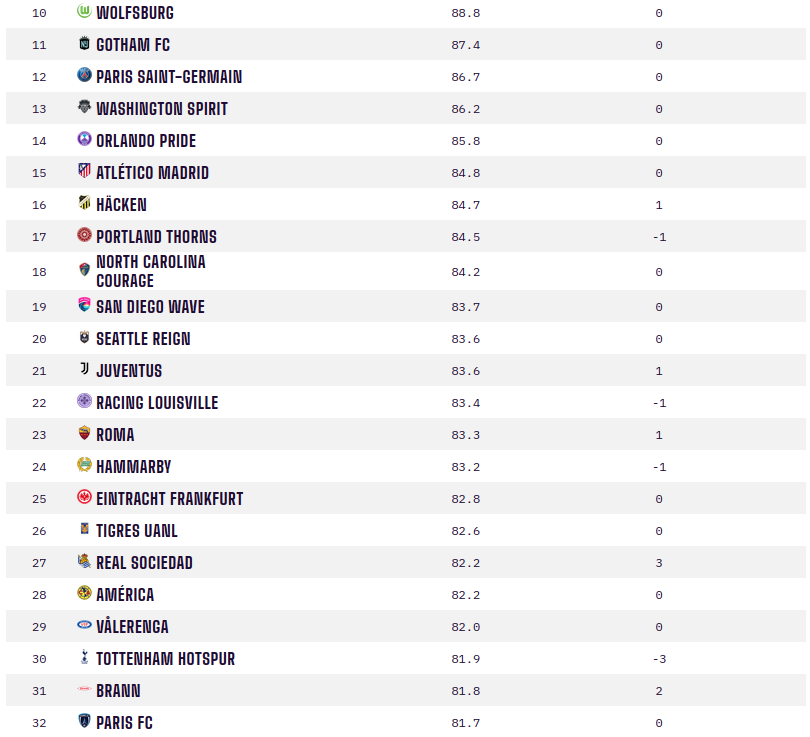
So let's go through the options for the next superclubs, first in Europe and then the Americas, looking at Opta's top clubs.
THE BIG EUROPEAN LEAGUE OPTIONS
The first thing to know about potential European superclubs is that it would be relatively easy, and, in many cases, fast, for a large or rich European men's club to invest in its women's team and turn it into a superclub – women's teams cost a fraction of what the men's sides do, and if you believe women's sports are a growth industry, it'll pay dividends down the road. (Both Real Madrid and Manchester United only came into existence in 2019, and were superclubs in five years or fewer.)
For example, Liverpool, a club that was able to win the WSL just over a decade ago, and now is in danger of a relegation fight – their men's side spent $500 million in transfers alone this past summer. 1/100th of that added to the women's team could notably improve them, 1/10th of it could raise them to "superclub" levels in a hurry. That's what's happening with London City Lionesses right now (and I'll write about that experiment soon), and could easily happen with Juventus, Inter Milan, Atletico Madrid, Glasgow Celtic, PSV, or any club that happens to get an interested and wealthy owner. There's no real ceiling on spending in Europe, which is a far cry from the US and NWSL, and being the biggest fish in a small pond hasn't hurt Barcelona or Lyon.
There's also prestige to consider. It is increasingly both cool for fans and good visibility for clubs to have strong women's teams, as Barcelona sees with Aitana Bonmati hanging out with Lamine Yamal, or Lyon continuing to seem like a big club thanks to their women's side even as the men's side collapsed into chaos. On the other hand, it's genuinely embarrassing for Liverpool to invest so much in their men's side as their once-proud women's side flirts with relegation.
THE CONTENDERS
The next European club listed on Opta is Atletico Madrid, and Atleti certainly fits the mold in many ways: they're in the Champions League knockout rounds this year, they have some notable stars (including Brazilian forward Gio, a favorite of mine), and there's certainly space in La Liga F for another power. But they're unlikely to make the Champions League again this season, with Real Sociedad taking a firm hold on third and it doesn't seem like they're investing massively.
Sociedad is an interesting club here, with young Portuguese star Andreia Jacinto, but not a ton of world-class players otherwise. Similarly, Athletic Club de Bilbao consistently hovers around competition for the top 3, but lacks superstars – in part because the club famously only signs Basque players.
The situation in France is similar but even fewer options. Paris FC's investment in its women's team makes it really the only fast option. Similarly to Atletico, they have one notable star (Clara Mateo), and are competitive enough in the Champions League but not likely to be favored in the knockout rounds. Similarly, Eintracht Frankfurt has invested more than most other German clubs, but they failed to make the Champions League group stage this year and are in a dogfight for third this time, instead of separating from the pack. On the other side, Bayer Leverkusen, a borderline superclub on the men's club, seem to be pushing for a stronger women's club, finishing increasingly high in the Frauen-Bundesliga, albeit without any notable superstars.
Finally, England's WSL has a few options for the next superclub, but English teams have a specific issue: with four big clubs already, and only three slots for the Champions League, there's only so much room for actual success. Still, Tottenham Hotspur has been slowly growing and building and is challenging for that Champions League slot right now, while London City Lionesses are investing quickly and already have a notable collection of stars.
THE MID-SIZED EUROPEAN LEAGUES
While it's possible someone bursts through in one of the above leagues, as you can see, I have some skepticism. But I do think the most likely options are in a league outside of the big four here: in particular, Italy, which is one of the top five leagues in men's football, but has long been behind in women's football. Their recent professionalization seems to already be paying dividends, with a trip to the Euro 2025 semifinals and one club in the Champions League knockouts.
That club, Juventus, is my pick for the next likely superclub in European football. They've been the dominant club in Serie A across the last decade, have several stars currently including Italian striker Christiana Girelli and Swiss midfielder Lia Walti, they went up 3-0 on mighty Lyon in the Champions League this year (before Lyon came back to make it 3-3. We also know that Juve, institutionally, believes in winning no matter what, for good or for ill. Juve's also been moving aggressively in this transfer window.
Two other big clubs in Italy are in the mix as well, particularly Roma, who seem likely to run away with the women's Serie A this season, and Inter Milan, who just beat Juventus to move into second.
The other mid-sized European leagues can be divided into the potentially rising powers and the older powers. The latter are primarily Scandinavian. Historically, Scandinavia, particularly Sweden and Norway, were one of the centers of women's soccer, but power has slowly shifted more and more toward Western Europe across the past two decades.
They still have some success, though. Sweden's Hacken and Norway's Brann, for example, both made the Champions League quarterfinals in 2024. While only Norway's Valerenga successfully qualified for the UCL league phase this season, the Women's Europa Cup has become a Scandanavian invitational, with four teams (two Swedish, one Danish, and one Icelandic) in the quarterfinals. Whether Sweden and Norway can become major club contenders in women's football again is an option question, but I think it would be cool if they could. I also think it unlikely.
Portugal is a sleeping giant in the same way as Italy – a top-tier men's football country that's been slow to invest in and be successful in women's football. They have several stars across the world, and Benfica did make the Champions League knockout last year, but I don't feel like they're likely to be ahead of Italy. Netherlands, Belgium, and Switzerland may also be worth keeping an eye on as well.
Next week we'll check in on the Orlando Pride and the rest of the NWSL, as well as clubs from the Americas generally.
LAST WEEK'S RESULTS
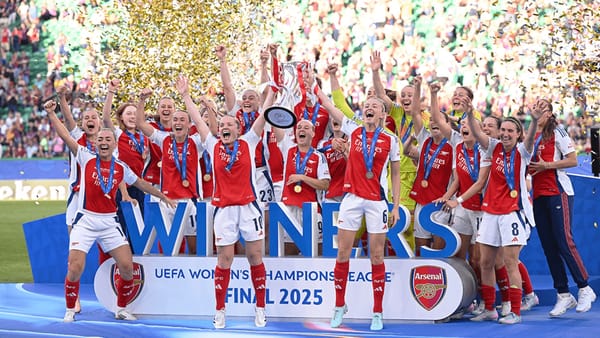
As mentioned, the FIFA Women's Champion's Cup took place last week, and mea culpa on the listings on that. In my defense, FIFA made it remarkably difficult to search for. Either way, as mentioned several times here, Corinthians stunned Gotham in the semi-finals, while Arsenal handled AS Far. In the final – worth over a million dollars – Arsenal took the lead twice over Corinthians, the Brazilians clawed the goal back, before Arsenal finally won in extra time.
Arguably even bigger news took place in Manchester, where City didn't merely beat Chelsea to all but claim the title, they utterly thrashed them, 5-1. Manchester City are now up 12 points on Chelsea with just eight matches to go, as well as 11 points over city rivals United and 13 on Arsenal, although with a game in hand, Arsenal are just about the last major competition – and they play each other next week.
Across the rest of Europe, the big clubs largely won their matches to hold serve, although both PSG and Koln gave Lyon and Wolfsburg, respectively, an intense match that the favorites were arguably lucky to win. In Mexico, the same was largely true, although Pachuca drew 2-2 with Tigres in the battle of the last two champions, while America beat Pumas 5-1 to lead the league on goal differential.
BEWARE THE AI "AUTO-DUBBING"
SOME HOUSEKEEPING
I've decided to split up the newsletter, with the article and weekend results ideally on Monday, and the recommended matches, news, and goal of the week on Thursday. I did this for two reasons: that major midweek matches are starting up again next week, and that it was getting ungainly with so many sections. This will probably just end up with me doing twice the work though.